- This event has passed.
Plunky & Oneness “Still We Rise: The Dream, the Duty, and the Divine Legacy”
February 1 @ 4:00 pm - 6:00 pm
Free – $15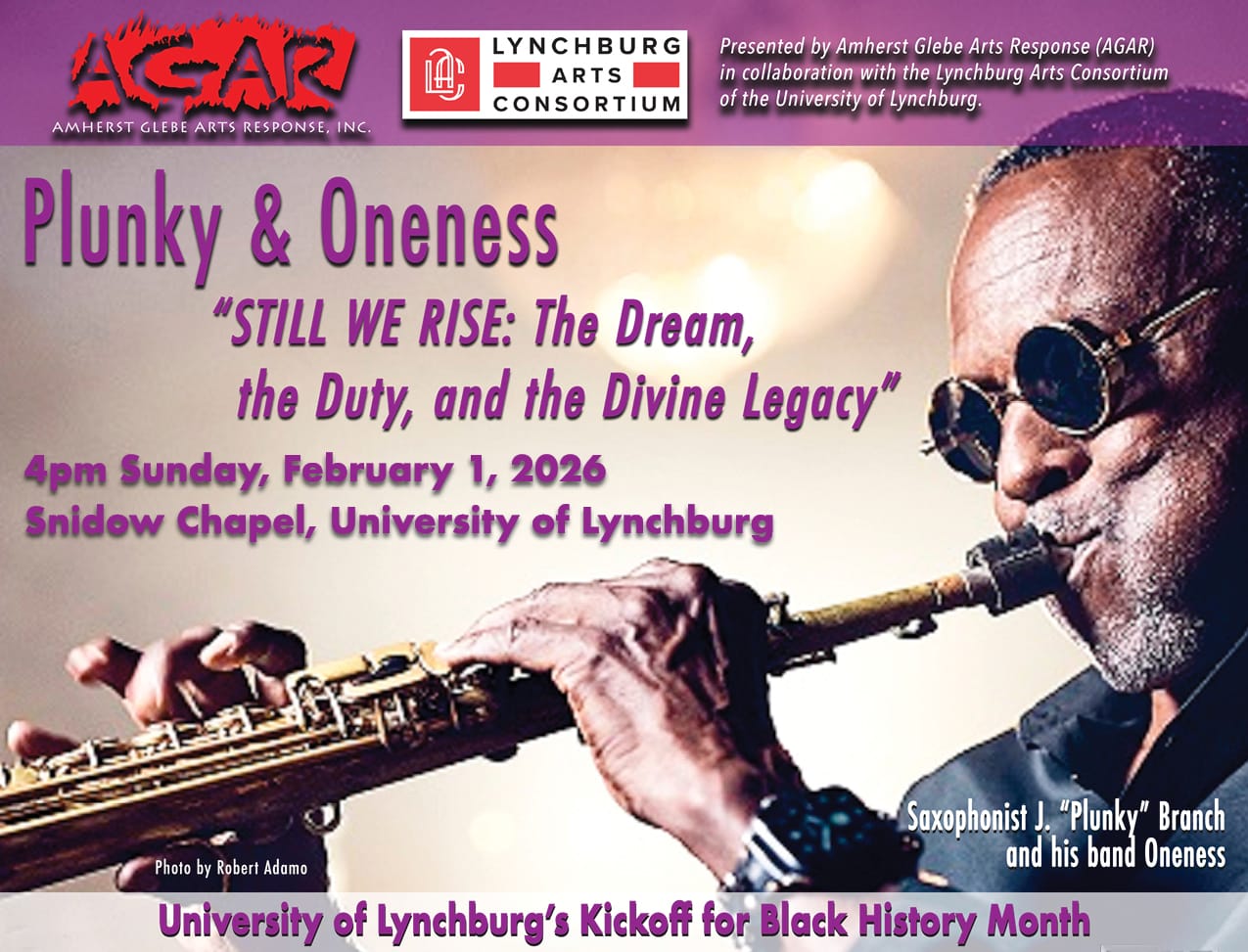
The kickoff for Black History Month at University of Lynchburg will be a concert by renowned Richmond saxophonist and bandleader J. Plunky Branch and his band, Oneness.
In the first set of the concert, Plunky & Oneness will explore historical black music from early African rhythms to colonial slave songs, ragtime and the jazz age; in the second set they will play rousing contemporary funk, jazz, African, rap and R&B tunes, of which many are Plunky’s original work.
This concert is presented by Amherst Glebe Arts Response, Inc. and the University of Lynchburg Arts Consortium. It is partially funded by a Touring Grant from the Virginia Commission for the Arts and the National Endowment for the Arts, and is also supported by the Greater Lynchburg Community Foundation, the Schewel Charitable Trust and the American Endowment Foundation.
J. PLUNKY BRANCH HISTORY: For over 50 years, Richmond saxophonist and bandleader J. Plunky Branch has been at the vanguard of Afro-centric jazz, funk, house music, and go-go, weaving these interrelated musical forms into a forward-looking message of empowerment, positivity and cultural awareness.
Plunky was born and raised in Richmond, where he was mentored as a teenager by local R&B musicians and music educators, including jazz violinist Joe Kennedy Jr. Acceptance to Columbia University found him leading a popular New York City soul band. “I took my Richmond R&B roots to New York, and I’ve since then brought back to Richmond what I’ve learned in New York, San Francisco, Europe, and West Africa,” he says.
At the same time, Plunky was discovering the avant-garde jazz sounds of Pharaoh Saunders and Archie Shepp, whose work displayed a burgeoning African consciousness. A move to San Francisco in 1969 led to his joining the band of exiled South African pianist and percussionist Ndikho Xaba. “Ndikho taught me that music could be more than entertainment. I learned that music could be a political force and that in African music the beauty is the function that it plays within society,” explains Plunky.
San Francisco is also where Plunky originally formed Juju in 1971. In 1973 the group moved to New York City, where Plunky lived and worked in a loft gallery space run by Ornette Coleman. In 1974, Plunky returned to Richmond, which marked a turning point in the group’s sound. “Audiences in Richmond weren’t as interested in avant-garde African jazz,” he laughs, so the group, now known as Oneness of Juju, combined its African roots with R&B and funk, adding trap drums and vocalist Lady Eka-Ete. Plunky also helped run Virginia’s first Black art gallery in Church Hill.
In 1975 Oneness of Juju’s landmark African Rhythms record was released on the pioneering DC-based indie label Black Fire. Frequent shows with Chuck Brown, EU and others meant that Plunky was present at the dawn of go-go music. Plunky’s band found itself able to move with the times, scoring early 1980s house/disco hits and touring in both Europe and Africa. In recent years, Plunky, who is a two-time recipient of NEA Jazz fellowships, has recorded in an urban/contemporary vein.
For more information about J. Plunky Branch, please read the “Overview” at https://www.eventbrite.com/e/plunky-oneness-still-we-rise-the-dream-the-duty-and-the-divine-legacy-tickets-1972862506866